
Follow us on Instagram

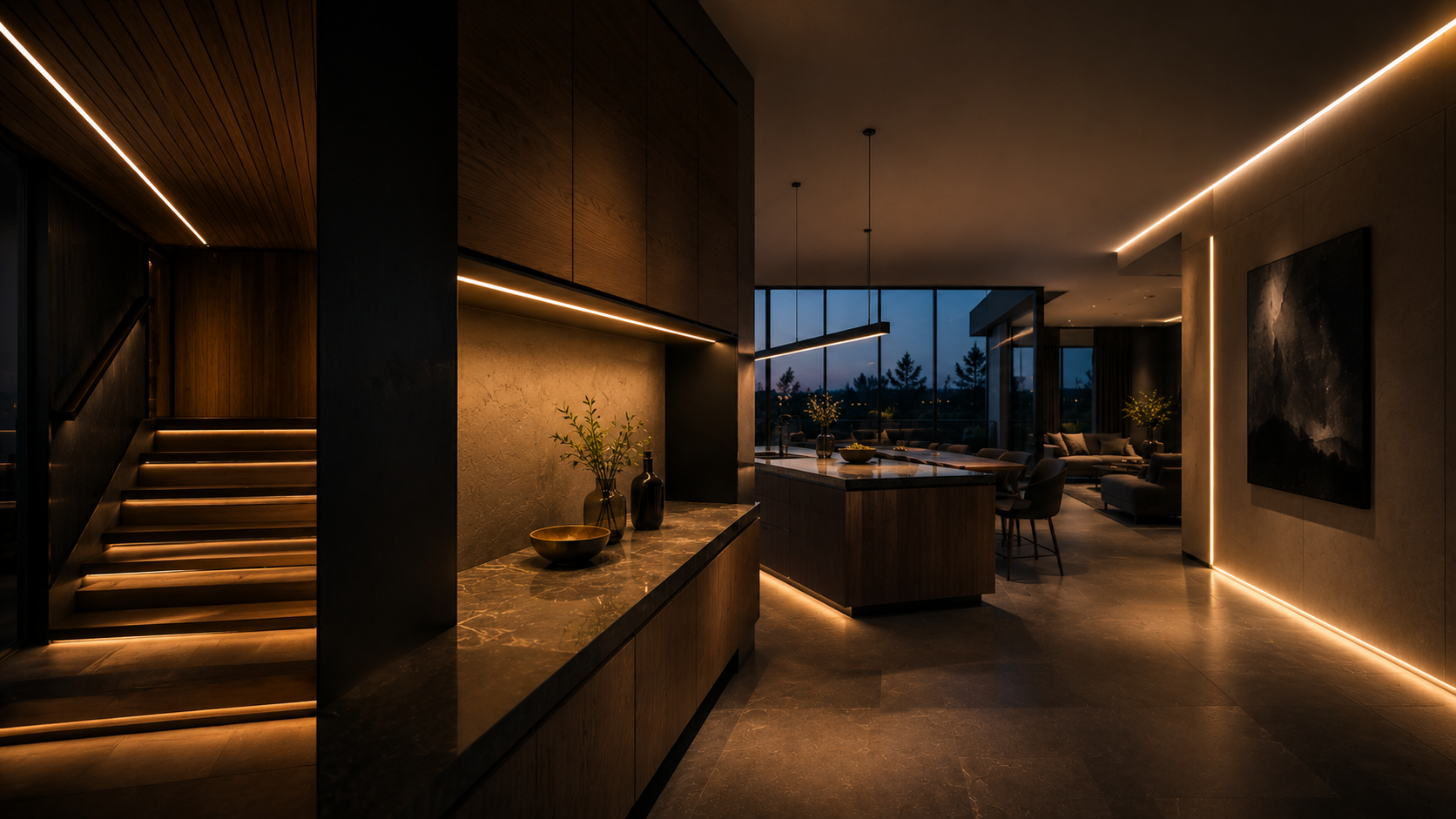
Choosing the right LED profile can make or break your lighting installation. Get it right and you end up with clean, even light that looks like it was designed into the space. Get it wrong and you're left with visible LED dots, poor heat management, and a finish that looks like an afterthought.
Whether you're fitting LED strip lights under kitchen cabinets, recessing them into ceilings, or running them along a commercial shop front, the LED aluminium profile (also called an LED channel or LED extrusion) is what turns a strip of LEDs into a proper lighting feature.
This guide covers the main types of LED profile, when to use each one, and how to match them to your LED strip for the best result.
An LED aluminium profile is a length of extruded aluminium that houses your LED strip. It typically comes with a clip-in diffuser cover, end caps, and mounting hardware. There are three main reasons to use one rather than sticking LED tape directly to a surface:
Light diffusion. A bare LED strip produces visible hotspots — individual points of light rather than a smooth, continuous glow. An LED diffuser (the frosted or opal cover that clips into the profile) spreads the light evenly. The result is a clean line of light with no dots visible.
Heat dissipation. LEDs generate heat, and heat kills LEDs. Aluminium profiles act as a heatsink, drawing heat away from the strip and extending its lifespan significantly. This matters most with higher-output strips running at 14W/m or above.
A professional finish. Profiles give your installation clean edges, consistent alignment, and a finished appearance. They also protect the LED strip from dust, moisture, and physical damage.
There are four main types of LED profile, each designed for a different installation method. The right choice depends on where you're fitting the strip and what finish you want.
A recessed LED profile sits flush with the surface it's installed into. You rout a channel into timber, plasterboard, or a worktop, press the profile in, and the light appears to come from within the material itself.
Best for: ceiling coves, under-cabinet lighting where you want a seamless look, staircase treads, joinery details.
What to look for: match the routed channel width to the profile's outer dimensions. Most recessed profiles use a spring-clip or friction-fit system. If you're working with plasterboard, check the depth — you need enough clearance behind the board.
Browse our recessed LED profiles →
Surface mounted profiles fix directly onto a flat surface using screws, adhesive tape, or mounting clips. They sit proud of the surface and are the easiest type to install.
Best for: under-cabinet lighting, display shelving, wardrobe interiors, cove lighting where recessing isn't practical, retail displays.
What to look for: consider the profile height. A slimmer surface mount profile (7-8mm) works well under cabinets where clearance is tight. Wider profiles (15-20mm) accommodate higher-output strips and give better diffusion.
Browse our surface mounted LED profiles →
Plaster-in profiles (sometimes called trimless profiles) are designed to be embedded in plasterboard ceilings or walls and then skimmed over so the profile edges disappear entirely. Only the diffuser and the light are visible — everything else is hidden.
Best for: high-end residential ceilings, architectural feature walls, commercial spaces where a completely seamless finish is required.
What to look for: plaster-in profiles have flanges that sit behind the plasterboard, and the face of the profile aligns with the finished plaster surface. They require first-fix installation before plastering. Plan the position carefully — once plastered in, you can't adjust them.
Suspended profiles hang from the ceiling on cables or rods, creating a floating light fitting. They're typically used as linear pendant lights in offices, studios, kitchens, or commercial spaces.
Best for: open-plan offices, kitchen islands, retail environments, conference rooms, studios.
What to look for: check the profile depth — suspended profiles tend to be deeper to accommodate the strip, driver wiring, and suspension hardware. Some designs emit light downward only, while others have a translucent top for up-and-down lighting.
Browse our suspended LED profiles →
Not every LED strip fits every profile. Here's what to check:
Strip width. Measure your LED strip's PCB width (the white or copper board the LEDs are mounted on). Common widths are 8mm, 10mm, and 12mm. Your profile's internal channel must be at least as wide as the strip — ideally 1-2mm wider for easy fitting. A 10mm strip in a 10mm channel is a very tight fit and can be frustrating to install.
Strip height. If you're using a COB LED strip or a strip with larger LED chips mounted on top, check that the diffuser cover doesn't press against the LEDs when clipped in. You need clearance between the top of the LEDs and the underside of the diffuser.
Wattage and heat. Higher-wattage strips (14W/m and above) produce more heat and benefit from wider, heavier profiles with more aluminium mass. Don't run a 20W/m strip in a slim 7mm profile — it won't dissipate heat effectively.
LED profiles come in a range of sizes. Here's a quick reference:
Slim profiles (15-17mm wide, 6-8mm deep) — ideal for subtle, low-profile installations like under cabinets or inside shelving. Best paired with 8-10mm strips up to 10W/m.
Standard profiles (17-20mm wide, 8-12mm deep) — the most versatile size. Works with most 10-12mm LED strips up to 14W/m. Good balance of diffusion and discreetness.
Wide profiles (25mm+ wide, 12-15mm deep) — designed for high-output strips, dual-row strips, or situations where you want maximum light diffusion. The extra width gives a broader, more even spread of light.
Diffuser options: most profiles accept either a clear or a frosted (opal) diffuser. Frosted diffusers hide individual LED dots and give a smooth light output — we recommend these for almost all installations. Clear diffusers preserve maximum brightness but show the LED chips, which rarely looks good in a finished space.
A few practical pointers that save time on site:
Cut cleanly. Use a mitre saw with a fine-tooth metal blade to cut aluminium profiles. A hacksaw works but leaves rough edges that need filing. Always deburr the cut end before inserting the LED strip.
Pre-wire before fixing. Run your LED strip through the profile and test it before permanently mounting anything. It's much easier to troubleshoot connections on a bench than on a ladder.
Use the right driver. Your LED driver needs to match the voltage (12V or 24V) and exceed the total wattage of the connected strips by at least 20%. Not sure how to size your driver? Read our LED driver sizing guide
Plan your joins. For runs longer than a single profile length (typically 1m or 2m), use joining connectors to create a seamless line. Slight misalignment between sections is very visible when the light is on, so take your time getting these straight.
Thermal paste helps. For high-wattage installations, applying a thin line of thermal paste between the LED strip and the aluminium channel improves heat transfer. This is especially worthwhile for strips running above 14W/m in enclosed spaces.
Match the profile's internal channel width to your LED strip's PCB width, plus 1-2mm for easy fitting. A 10mm strip works best in a 12mm channel. For depth, make sure the diffuser doesn't press against the LED chips when clipped in.
Yes — that's exactly what plaster-in (trimless) profiles are designed for. They have flanges that sit behind the plasterboard and get skimmed over during plastering, leaving only the diffuser face visible. Standard recessed or surface profiles should not be plastered over.
Recessed profiles sit inside a channel cut or routed into the surface, so the profile sits flush and the light appears integrated. Surface mounted profiles fix onto the face of a surface and sit proud. Recessed gives a cleaner look but requires more preparation work. Surface mount is faster to install and easier to access later.
Yes. Aluminium is an excellent thermal conductor. The profile acts as a heatsink, drawing heat away from the LED strip and spreading it along the length of the channel. This reduces the operating temperature of the LEDs and extends their lifespan. Without a profile, higher-wattage strips can overheat and degrade much faster.
For almost all installations, we recommend a frosted (opal) diffuser. It eliminates visible LED dots and creates a smooth, even line of light. Clear diffusers are only worth using where maximum brightness is critical and the profile is hidden from direct view — for example, inside a light box or behind a panel.
Technically yes — most LED strips have adhesive backing. But without a profile you lose diffusion (you'll see individual dots), heat management (shorter lifespan), and protection. For any visible installation, a profile is well worth the small extra cost.
Get in touch — we're happy to advise on the best setup for your installation, whether it's a single kitchen run or a full commercial fit-out.

.jpeg)
.jpeg)


.svg)


