
Follow us on Instagram

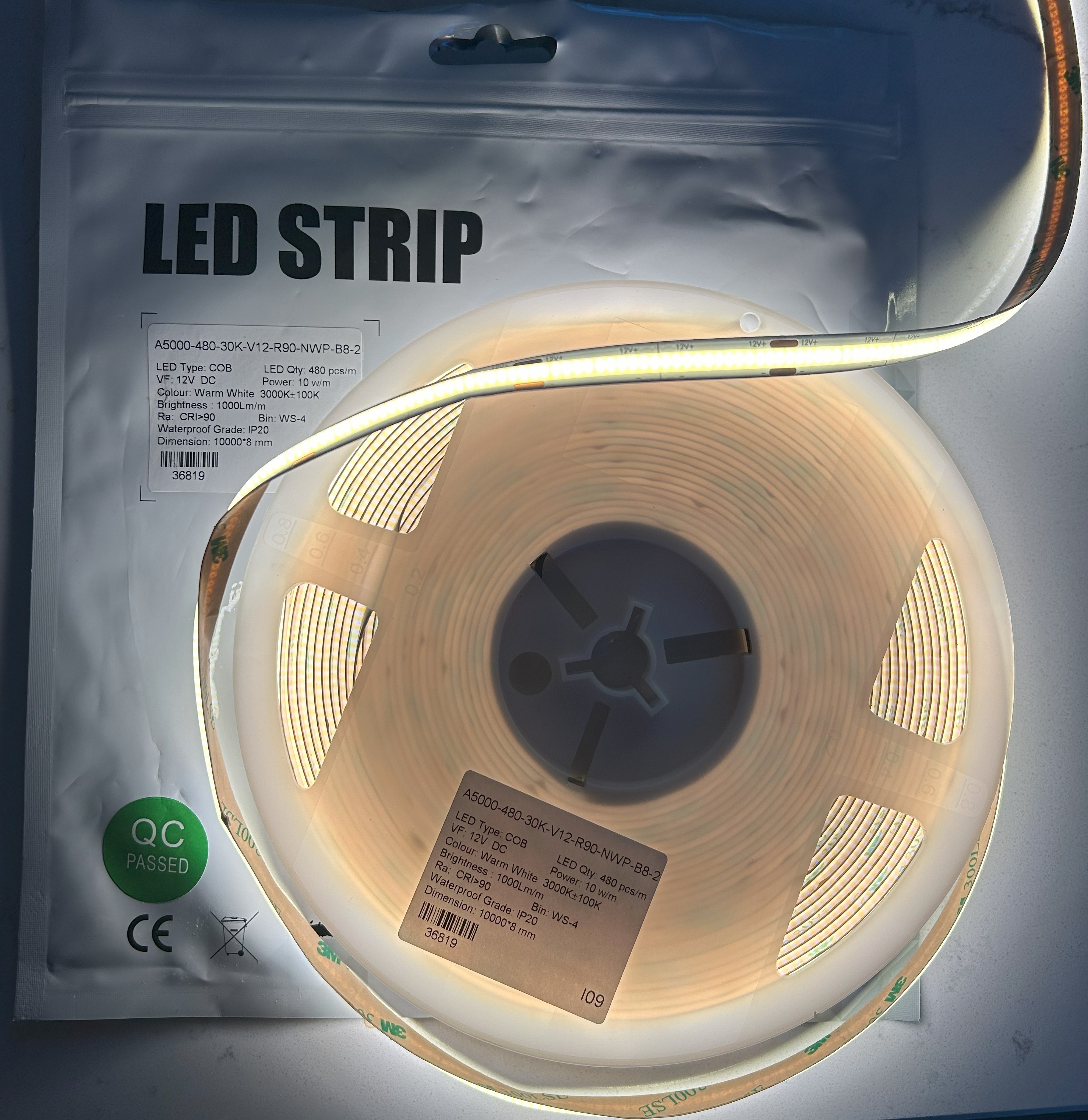
The short answer: for most kitchen, room and commercial installations, 24V LED strip is the better choice. It can run roughly twice as far as 12V before brightness drops, draws half the current for the same power, and needs thinner cable. Choose 12V for short runs, small cabinets and furniture, or where a 12V supply is specifically required.
As current travels along an LED strip, the voltage gradually falls. On a long run you'll see the far end become dimmer or change colour slightly. Because a 24V strip carries half the current of a 12V strip at the same wattage, voltage drop is much lower. As a rule of thumb, a 12V strip can usually run about 5m from one feed, while a 24V strip can usually run about 10m, depending on wattage.
No. The driver voltage must match the strip voltage exactly. A 12V driver will under-power a 24V strip, and a 24V driver will damage a 12V strip.
Multiply the strip's watts per metre by the total length, then add around 20% headroom. For example, 8m of 10W/m strip is 80W, so choose a 100W driver. Our LED driver guide walks through more examples.
Feed power into both ends of the strip, or inject power at the midpoint, from the same driver. For very long runs, split the load across two drivers. Read more on avoiding voltage drop on long LED strip runs.
Not inherently. Brightness depends on the strip's watts and lumens per metre. 24V simply stays evenly bright over longer distances.
No. Power use depends on watts per metre, not voltage. A 10W/m strip uses 10W per metre on either voltage.
Shop our 24V LED drivers and 12V LED drivers, or call 01244 722781 and we'll help you choose.


